Karan Thapar: Hello and welcome to the Devil's Advocate. As the debate over the reservations for the OBCs divides the country, we ask: What are the government's real intentions? That is the critical questions that I shall put today in an exclusive interview to the Minister for Human Resource Development Arjun Singh.
Karan Thapar:Most of the people would accept that steps are necessary to help the OBCs gain greater access to higher education. The real question is: Why do you believe that reservations is the best way of doing this?
Arjun Singh: I wouldn't like to say much more on this because these are decisions that are taken not by individuals alone. And in this case, the entire Parliament of this country - almost with rare unanimity - has decided to take this decision.
Karan Thapar: Except that Parliament is not infallible. In the Emergency, when it amended the Constitution, it was clearly wrong, it had to reverse its own amendments. So, the question arises: Why does Parliament believe that the reservation is the right way of helping the OBCs?
Arjun Singh: Nobody is infallible. But Parliament is Supreme and at least I, as a Member of Parliament, cannot but accept the supremacy of Parliament.
Karan Thapar: No doubt Parliament is supreme, but the Constitutional amendment that gives you your authorities actually enabling amendment, it is not a compulsory requirement. Secondly, the language of the amendment does not talk about reservations, the language talks about any provision by law for advancement of socially and educationally backward classes. So, you could have chosen anything other than reservations, why reservations?
Arjun Singh: Because as I said, that was the 'will and desire of the Parliament'.
Karan Thapar: Do you personally also, as Minister of Human Resource Development, believe that reservations is the right and proper way to help the OBCs?
Arjun Singh: Certainly, that is one of the most important ways to do it.
Karan Thapar: The right way?
Arjun Singh: Also the right way.
Karan Thapar: In which case, lets ask a few basic questions. We are talking about the reservations for the OBCs in particular. Do you know what percentage of the Indian population is OBC? Mandal puts it at 52 per cent, the National Sample Survey Organisation (NSSO) at 32 per cent, the National Family and Health Survey at 29.8 per cent, which is the correct figure?
Arjun Singh: I think that should be decided by people who are more knowledgeable. But the point is that the OBCs form a fairly sizeable percentage of our population.
Karan Thapar: No doubt, but the reason why it is important to know 'what percentage' they form is that if you are going to have reservations for them, then you must know what percentage of the population they are, otherwise you don't know whether they are already adequately catered to in higher educational institutions or not.
Arjun Singh: That is obvious - they are not.
Karan Thapar: Why is it obvious?
Arjun Singh: Obvious because it is something which we all see.
Karan Thapar: Except for the fact that the NSSO, which is a government appointed body, has actually in its research in 1999 - which is the most latest research shown - that 23.5 per cent of all university seats are already with the OBCs. And that is just 8.5 per cent less than what the NSSO believes is the OBC share of the population. So, for a difference of 8 per cent, would reservations be the right way of making up the difference?
Arjun Singh: I wouldn't like to go behind all this because, as I said, Parliament has taken a view and it has taken a decision, I am a servant of Parliament and I will only implement.
Karan Thapar: Absolutely, Parliament has taken a view, I grant it. But what people question is the simple fact - Is there a need for reservations? If you don't know what percentage of the country is OBC and if, furthermore, the NSSO is correct in pointing out that already 23.5 per cent of the college seats are with the OBC, then you don't have a case in terms of need.
Arjun Singh: College seats, I don't know.
Karan Thapar: According to the NSSO - which is a government appointed body - 23.5 per cent of the college seats are already with the OBCs.
Arjun Singh: What do you mean by college seats?
Karan Thapar: University seats, seats of higher education.
Arjun Singh: Well, I don't know I have not come across that so far.
Karan Thapar: So, when critics say to you that you don't have a case for reservation in terms of need, what do you say to them?
Arjun Singh: I have said what I had to say and the point is that that is not an issue for us to now debate.
Karan Thapar: You mean the chapter is now closed?
Arjun Singh: The decision has been taken.
Karan Thapar: Regardless of whether there is a need or not, the decision is taken and it is a closed chapter.
Arjun Singh: So far as I can see, it is a closed chapter and that is why I have to implement what all Parliament has said.
Karan Thapar: Minister, it is not just in terms of 'need' that your critics question the decision to have reservation for OBCs in higher education. More importantly, they question whether reservations themselves are efficacious and can work.
For example, a study done by the IITs themselves shows that 50 per cent of the IIT seats for the SCs and STs remain vacant, and for the remaining 50 per cent, 25 per cent are the candidates who even after six years fail to get their degrees. So, clearly, in their case, reservations are not working.
Arjun Singh: I would only say that on this issue, it would not be correct to go by all these figures that have been paraded.
Karan Thapar: You mean the IIT figures themselves could be dubious?
Arjun Singh: Not dubious, but I think that is not the last word.
Karan Thapar: All right, maybe the IIT may not be the last word, let me then quote to you the report of the Parliamentary Committee on the welfare for the Scheduled Castes and Scheduled Tribes - that is a Parliamentary body.
It says, that looking at the Delhi University, between 1995 and 2000, just half the seats for under-graduates at the Scheduled Castes level and just one-third of the seats for under-graduates at the Scheduled Tribes level were filled. All the others went empty, unfilled. So, again, even in Delhi University, reservations are not working.
Arjun Singh: If they are not working, it does not mean that for that reason we don't need them. There must be some other reason why they are not working and that can be certainly probed and examined. But to say that for this reason, 'no reservations need to be done' is not correct.
Karan Thapar: Fifty years after the reservations were made, statistics show, according to The Hindustan Times, that overall in India, only 16 per cent of the places in higher education are occupied by SCs and STs. The quota is 22.5 per cent, which means that only two-thirds of the quota is occupied. One-third is going waste, it is being denied to other people.
Arjun Singh: As I said, the kind of figures that have been brought out, in my perception, do not reflect the realities. Realities are something much more and, of course, there is an element of prejudice also.
Karan Thapar: But these are figures that come from a Parliamentary Committee. It can't be prejudiced; they are your own colleagues.
Arjun Singh: Parliamentary Committee has given the figures, but as to why this has not happened, that is a different matter.
Karan Thapar: I put it to you that you don't have a case for reservations in terms of need, you don't have a case for reservations in terms of their efficacy, why then, are you insisting on extending them to the OBCs?
Arjun Singh: I don't want to use that word, but I think that your argument is basically fallacious.
Karan Thapar: But it is based on all the facts available in the public domain.
Arjun Singh: Those are facts that need to be gone into with more care. What lies behind those facts, why this has not happened, that is also a fact.
Karan Thapar: Let’s approach the issue of reservations differently in that case. Reservations mean that a lesser-qualified candidate gets preference over a more qualified candidate, solely because in this case, he or she happens to be an OBC. In other words, the upper castes are being penalised for being upper caste.
Arjun Singh: Nobody is being penalised and that is a factor that we are trying to address. I think that the Prime Minister will be talking to all the political parties and will be putting forward a formula, which will see that nobody is being penalised.
Karan Thapar: I want very much to talk about that formula, but before we come to talk about how you are going to address concerns, let me point one other corollary: Reservations also gives preference and favour to caste over merit. Is that acceptable in a modern society?
Arjun Singh: I don't think the perceptions of modern society fit India entirely.
Karan Thapar: You mean India is not a modern society and therefore can't claim to be treated as one?
Arjun Singh: It is emerging as a modern society, but the parameters of a modern society do not apply to large sections of the people in this country.
Karan Thapar: Let me quote to you Jawaharlal Nehru, a man whom you personally admire enormously. On the 27th of June 1961 wrote to the Chief Ministers of the day as follows: I dislike any kind of reservations. If we go in for any kind of reservations on communal and caste basis, we will swamp the bright and able people and remain second-rate or third-rate. The moment we encourage the second-rate, we are lost. And then he adds pointedly: This way lies not only folly, but also disaster. What do you say to Jawaharlal Nehru today?
Arjun Singh: Jawaharlal Nehru was a great man in his own right and not only me, but everyone in India accept his view.
Karan Thapar: But you are just about to ignore his advice.
Arjun Singh: No. Are you aware that it was Jawaharlal Nehru who introduced the first amendment regarding OBCs?
Karan Thapar: Yes, and I am talking about Jawaharlal Nehru in 1961, when clearly he had changed his position, he said, “I dislike any kind of reservations”.
Arjun Singh: I don't think one could take Panditji's position at any point of time and then overlook what he had himself initiated.
Karan Thapar: Am I then to understand that regardless of the case that is made against reservations in terms of need, regardless of the case that has been made against reservations in terms of efficacy, regardless of the case that has been made against reservations in terms of Jawaharlal Nehru, you remain committed to extending reservations to the OBCs.
Arjun Singh: I said because that is the will of Parliament. And I think that common decisions that are taken by Parliament have to be honoured.
Karan Thapar: Let me ask you a few basic questions. If reservations are going to happen for the OBCs in higher education, what percentage of reservations are we talking about?
Arjun Singh: No, that I can't say because that has yet to be decided.
Karan Thapar: One, then, last quick question. Do you think this is an issue, which is a sensitive issue, where everyone knew there would have been passions and emotions that would have been aroused has been handled as effectively as it should have been?
Arjun Singh: Well, I have not done anything on it. I have not, sort of what you call, jumped the gun. If this is an issue, which is sensitive, everyone has to treat it that way.
Karan Thapar: But your conscience as HRD Minister is clear?
Arjun Singh: Absolutely clear.
Karan Thapar: There is nothing that you could have done to make it easier for the young students?
Arjun Singh: Well, I am prepared to do anything that can be done. And it is being attempted.
Karan Thapar: For seven weeks, they have been protesting in the hot sun. No minister has gone there to appease them, to allay their concerns, to express sympathy for them. Have politicians let the young people of India down?
Arjun Singh: Well, I myself called them. They all came in this very room.
Karan Thapar: But you are the only one.
Arjun Singh: You are accusing me only. No one else is being accused.
Karan Thapar: What about the Government of India? Has the Government of India failed to respond adequately?
Arjun Singh: From the Government of India also, the Defence Minister met them.
Karan Thapar: Only recently.
Arjun Singh: That is something because everyone was busy with the elections.
Karan Thapar: For seven weeks no one met them.
Arjun Singh: No, but we are very concerned. Certainly, all of us resent the kind of force that was used. I condemned it the very first day it happened.
Karan Thapar: All right, Mr Arjun Singh. We have reached the end of this interview. Thank you very much for speaking on the subject.
Arjun Singh: I can't say anything on that, I have told you in the very beginning that at this point of time it is not possible for me to.
Karan Thapar: Quite right. If you can't say, then that also means that the figure has not been decided.
Arjun Singh: The figure will be decided, it has not been decided yet.
Karan Thapar: The figure has not been decided. So, therefore the figure could be 27, but it could be less than 27, too?
Arjun Singh: I don't want to speculate on that because as I said, that is a decision which will be taken by Parliament.
Karan Thapar: Whatever the figure, one thing is certain that when the reservations for OBCs happen, the total quantum of reservations will go up in percentage terms. Will you compensate by increasing the total number of seats in colleges, universities, IITs and IIMs so that the other students don't feel deprived.
Arjun Singh: That is one of the suggestions that has been made and is being seriously considered.
Karan Thapar: Does it find favour with you as a Minister for Human Resource Development?
Arjun Singh: Whatever suggestion comes, we are committed to examine it.
Karan Thapar: You may be committed to examine it, but do you as minister believe that that is the right way forward?
Arjun Singh: That could be one of the ways, but not the only way.
Karan Thapar: What are the other ways?
Arjun Singh: I don't know. That is for the Prime Minister and the other ministers to decide.
Karan Thapar: One way forward would be to increase the total number of seats.
Arjun Singh: Yes, definitely.
Karan Thapar: But the problem is that, as the Times of India points out, we are talking of an increase of perhaps as much as 53 per cent. Given the constraints you have in terms of faculty and infrastructure, won't that order of increase dilute the quality of education?
Arjun Singh: I would only make one humble request, don't go by The Times of India and The Hindustan Times about faculty and infrastructure, because they are trying to focus on an argument which they have made.
Karan Thapar: All right, I will not go by The Times of India, let me instead go by Sukhdev Thorat, the Chairman of the UGC. He points out that today, at higher education levels - that is all universities, IITs and IIMs - there is already a 1.2 lakh vacancy number. Forty per cent of these are in teaching staff, which the IIT faculty themselves point out that they have shortages of up to 30 per cent. Given those two constraint, can you increase the number of seats?
Arjun Singh: That can be addressed and that shortage can be taken care of.
Karan Thapar: But it can't be taken care of in one swoop, it will take several years to do it.
Arjun Singh: I don't know whether it can be taken care of straightway or in stages, that is a subject to be decided.
Karan Thapar: Let me ask you bluntly, if you were to agree to compensate for reservations for OBCs by increasing the number of seats, would that increase happen at one go, or would it be staggered over a period of two-three or four year old process.
Arjun Singh: As I told you, it is an issue that I cannot comment upon at this moment because that is under examination.
Karan Thapar: So, it may happen in one go and it may happen in a series of several years.
Arjun Singh: I can't speculate on that because that is not something on which I am free to speak on today.
Karan Thapar: Will the reservation for OBCs, whatever figure your Committee decides on, will it happen in one go, or will it slowly be introduced in stages?
Arjun Singh: That also I cannot say because, as I told you, all these issues are under consideration.
Karan Thapar: Which means that everything that is of germane interest to the people concerned is at the moment 'under consideration' and the government is not able to give any satisfaction to the students who are deeply concerned.
Arjun Singh: That is not the point. The government knows what to do and it will do what is needed.
Karan Thapar: But if the government knows what to do, why won't you tell me what the government wants to do?
Arjun Singh: Because unless the decision is taken, I cannot tell you.
Karan Thapar: But you can share with me as the minister what you are thinking.
Arjun Singh: No.
Karan Thapar: So, in other words, we are manitaining a veil of secrecy and the very people who are concerned...
Arjun Singh: I am not maintaining a veil of secrecy. I am only telling you what propriety allows me to tell you.
Karan Thapar: Propriety does not allow you to share with the people who are protesting on the streets what you are thinking of?
Arjun Singh: I don't think that that can happen all the time.
Karan Thapar: But there are people who feel that their lives and their futures are at stake and they are undertaking fasts until death.
Arjun Singh: It is being hyped up, I don't want to go into that.
Karan Thapar: Do you have no sympathy for them?
Arjun Singh: I have every sympathy.
Karan Thapar: But you say it is being hyped up.
Arjun Singh: Yes, it is hyped up.
Karan Thapar: So, then, what sympathy are you showing?
Arjun Singh: I am showing sympathy to them and not to those who are hyping it up.
Karan Thapar: The CPM says that if the reservations for the OBCs are to happen, then what is called the ‘creamy layer’ should be excluded. How do you react to that?
Arjun Singh: The ‘creamy layer’ issue has already been taken care of by the Supreme Court.
Karan Thapar: That was vis-a-vis jobs in employment, what about at the university level, should they be excluded there as well because you are suggesting that the answer is yes?
Arjun Singh: That could be possible.
Karan Thapar: It could be possible that the ‘creamy layer’ is excluded from reservations for OBCs in higher education?
Arjun Singh: It could be, but I don't know whether it would happen actually.
Karan Thapar: Many people say that if reservations for OBCs in higher education happen, then the children of beneficiaries should not be entitled to claim the same benefit.
Arjun Singh: Why?
Karan Thapar: So that there is always a shrinking base and the rate doesn't proliferate.
Arjun Singh: I don't think that that is a very logical way of looking at it.
Karan Thapar: Is that not acceptable to you?
Arjun Singh: No, it is not the logical way of looking at it.
Karan Thapar: So, with the possible exception of the creamy layer exclusion, reservation for OBCs in higher education will be almost identical to the existing reservations for SC/STs?
Arjun Singh: Except for the percentage.
Karan Thapar: Except for the percentage.
Arjun Singh: Yes.
Karan Thapar: So, in every other way, they will be identical.
Arjun Singh: Yes, in every other way.
Karan Thapar: Mr Arjun Singh, on the 5th of April when you first indicated that the Government was considering reservation for OBCs in higher education, was the Prime Minister in agreement that this was the right thing to do?
Arjun Singh: I think, there is a very motivated propaganda on this issue. Providing reservation to OBCs was in the public domain right from December 2005, when Parliament passed the enabling resolution.
Karan Thapar: Quite true. But had the Prime Minister specifically agreed on or before 5th of April to the idea?
Arjun Singh: Well, I am telling you it was already there. A whole Act was made, the Constitution was amended and the Prime Minister was fully aware of what this is going to mean. Actually, he had a meeting in which OBC leaders were called to convince them that this would give them the desired advantage. And they should, therefore, support this resolution. And at that meeting, he himself talked to them. Now, how do you say that he was unaware?
Karan Thapar: But were you at all aware that the Prime Minister might be in agreement with what was about to happen but might not wish it disclosed publicly at that point of time? Were you aware of that?
Arjun Singh: It was already there in public domain, that's what I am trying to tell you.
Karan Thapar: Then answer this to me. Why are members of the PMO telling journalists that Prime Minister was not consulted and that you jumped the gun?
Arjun Singh: Well, I don't know which member of the PMO you are talking about unless you name him.
Karan Thapar: Is there a conspiracy to make you the Fall Guy?
Arjun Singh: Well, I don't know whether there is one or there is not. But Fall Guys are not made in this way. And I am only doing what was manifestly clear to every one, was cleared by the party and the Prime Minister. There is no question of any personal agenda.
Karan Thapar: They say that, in fact, you brought up this issue to embarrass the Prime Minister.
Arjun Singh: Why should I embarrass the Prime Minister? I am with him. I am part of his team.
Karan Thapar: They say that you have a lingering, forgive the word, jealousy because Sonia Gandhi chose Manmohan Singh and not you as Prime Minister.
Arjun Singh: Well, that is canard which is below contempt. Only that person can say this who doesn't know what kind of respect and regard I hold for Sonia Gandhi. She is the leader. Whatever she decides is acceptable to me.
Karan Thapar: They also say that you brought this issue up because you felt that the Prime Minister had been eating into your portfolio. Part of it had gone to Renuka Chaudhury and, in fact, your new deputy minister Purandar Sridevi had taken over certain parts. This was your way of getting back.
Arjun Singh: No one was taking over any part. This is a decision which the Prime Minister makes as to who has to have what portfolio. And he asked Mrs Renuka Devi to take it and he cleared it with me first.
Karan Thapar: So there is no animus on your part?
Arjun Singh: Absolutely not.
Karan Thapar: They say that you did this because you resented the Prime Minister's popular image in the country, that this was your way of embroiling him in a dispute that will make him look not like a modern reformer but like an old-fashioned, family-hold politician instead.
Arjun Singh: Well, the Tammany Hall political stage is over. He is our Prime Minister and every decision he has taken is in the full consent with his Cabinet and I don't think there can be any blame on him.
Karan Thapar: One, then, last quick question. Do you think this is an issue, which is a sensitive issue, where everyone knew there would have been passions and emotions that would have been aroused has been handled as effectively as it should have been?
Arjun Singh: Well, I have not done anything on it. I have not, sort of what you call, jumped the gun. If this is an issue, which is sensitive, everyone has to treat it that way.
Karan Thapar: But your conscience as HRD Minister is clear?
Arjun Singh: Absolutely clear.
Karan Thapar: There is nothing that you could have done to make it easier for the young students?
Arjun Singh: Well, I am prepared to do anything that can be done. And it is being attempted.
Karan Thapar: For seven weeks, they have been protesting in the hot sun. No minister has gone there to appease them, to allay their concerns, to express sympathy for them. Have politicians let the young people of India down?
Arjun Singh: Well, I myself called them. They all came in this very room.
Karan Thapar: But you are the only one.
Arjun Singh: You are accusing me only. No one else is being accused.
Karan Thapar: What about the Government of India? Has the Government of India failed to respond adequately?
Arjun Singh: From the Government of India also, the Defence Minister met them.
Karan Thapar: Only recently.
Arjun Singh: That is something because everyone was busy with the elections.
Karan Thapar: For seven weeks no one met them.
Arjun Singh: No, but we are very concerned. Certainly, all of us resent the kind of force that was used. I condemned it the very first day it happened.
Karan Thapar: All right, Mr Arjun Singh. We have reached the end of this interview. Thank you very much for speaking on the subject.
Thursday, May 25, 2006
Karan Thapar interviews Arjun Singh - Transcript
Tuesday, May 23, 2006
Role Play??
1) Project Manager is a Person who thinks nine women can deliver a baby in One month.
2) Developer is a Person who thinks it will take 18 months to deliver a Baby.
3) Onsite Coordinator is one who thinks single woman can deliver nine babies in one month.
4) Client is the one who doesn't know why he wants a baby.
5) Marketing Manager is a person who thinks he can deliver a baby even if no man and woman are available.
6) Resource Optimization Team thinks they don't need a man or woman; they'll produce a child with zero resources.
7) Documentation Team thinks they don't care whether the child is delivered, they'll just document 9 months.
8) Quality Auditor is the person who is never happy with the PROCESS to Produce a baby.
9) Tester is a person who always tells his wife that this is the Right baby
Brand YOU
In a conversation, when you happen to talk about your boss, what are the adjectives that come to your mind? Arrogant? Ruthless? Caring? Sensitive? Well, the responses may vary from person to person, depending on the relationship that one shares with his/her dearest reporting authority. But, today things have changed.
With the scarcity of relevant talent in the market, the super bosses from across industries are taking the initiative to alter that perception. After having done with branding your organisation as an ideal employer, chief executives and corporate gurus have realised that they need to pay close attention to how employees perceive them and what are the attributes that they associate with them.
“It’s important to brand oneself to create an identity in the corporate world. The corporate market, just as product markets is filled with many ‘me-too’ quality brands. And just as consumers react from the heart, so do fellow colleagues, subordinates and bosses- they too are human and there is always a dimension beyond performance that comes into play. So branding in the corporate scenario helps the individual to stand out in his/her own way. However, you must remember that you don’t really have to cultivate a brand.
"Be yourself. Don’t follow the book - otherwise you will always look like any other brand," explains Piyush Pandey, Executive Chairman & National Creative Director, Ogilvy & Mather Limited.
Can you see me? Visibility is another critical aspect of individual branding. When you’re the chief or the organisational representative, everything that you say or do could have larger implications. And the process of building one’s individual brand requires one to pay close attention to that.
“There is merit in creating visibility for oneself. I don’t keep a conscious check on where I am seen or with whom but I am conscious of where I am and what I say/do there because, it does have an impact on the audience’s view of me and the organisation I represent. In fact for me, the bigger thing to be sensitive about is to remember that I am not only Piyush Pandey-the individual, but I also represent the Ogilvy Group as its executive chairman,” believes Pandey.
One’s individual brand depends largely upon the nature of the person in question. If the person is charismatic and flamboyant, he/she should be able to put across a good enough personal brand.
“I know of some people in our business who are very good at creating and maintaining a well crafted public persona and in my belief, some of what they do borders on over-promoting oneself, perhaps at the cost of workplace productivity. It also depends a lot on your personal brand. In general, extrovert and socially active people manage their visibility better than ‘private’ people,” explains Kiran.
Making a point often, the way you extend minor courtesies (reply to emails/text messages etc.) or even the way you interact with colleagues could reflect your own personality and all this adds up to your individual brand. And carving a pleasant, helpful and approachable personality would require you to act accordingly.
“The way our peers, whether colleagues or friends, perceive us has a strong bearing on how productive we are in a team. If majority of my peers perceive me as a pain in the hind quarters, they will naturally get non co-operative towards me, pulling down not just my performance, but the whole team’s,” explains Ravi Kiran, CEO, Starcom MediaVest Group - South Asia.
Kiran further explains, “I believe my team members think of me as a people-sensitive, future focused, empowering, democratic, idea-sensitive and no-nonsense person. My daily workplace actions has contributed to creating this perception. I am an active participant in ideation sessions. Even outside formal sessions, I share my personal ideas quite freely with my team, and I do not encourage political behaviour. I have been very vocal within my organisation for the need to create a highly participative, rather than an autocratic workplace. I urge my colleagues through internal communication and at the time of evaluation, I tell them to focus on their own and their subordinates’ inherent talent rather than weaknesses.” Altering the way people perceive you can be a challenging task. And the only way out is to work towards building your brand through your actions and deeds that need to reflect what you stand for.
“I think I am seen as obviously creative, certainly one who likes ‘playing off the front foot’- that’s my principle in life; as one who is accessible and approachable; who takes his job seriously, but not oneself seriously. And yes, I’d like to be seen as an optimist who believes failure is okay and big postmortems are a waste of time. The only steps I take are to ensure that what I say and do remain true to this,” concludes Pandey.
Source: The Economic Times
Friday, May 19, 2006
Joel on software
Joel Spolsky has been writing on software, business, management, internet since 2000 on his site.
I found the archive there and i must warn you that if you have got work to do, please dont go to it. I had work to finish and i went there and was stuck there for quite some time.
Joel has a funny side to him and an incredible of simplifying things.
Better be postponed for some day when i dont have much work..
Hope you like the articles in the archive. Enjoy!
Guy Kawasaki's listing of The Top Ten Lies
Here are the links to Guy Kawasaki's lists of the top ten lies of
Venture Capitalists
Marketing Gurus
Engineers
Corporate Partners
Entrepreneurs
Sunday, May 14, 2006
What's in a name??
I received this forward about a month ago. Some nice old pictures. Funny how some of these revolutionary technologists figured out what to name their company or technology.
Tim Berners Lee -- Founder of the World Wide Web
Bill Hewlett(L) and Dave Packard(R) of HP. Behind them in the picture is the famous HP Garage. Bill Hewlett and Dave Packard tossed a coin to decide whether the company they founded would be called Hewlett-Packard or Packard-Hewlett. And the winner was not Bill... the winner was Dave.
Larry Page(L) and Sergey Brin(R), founders of Google. Google was originally intended to be named 'Googol'. It was spelt wrongly as 'Google'. So they kept the name as GOOGLE.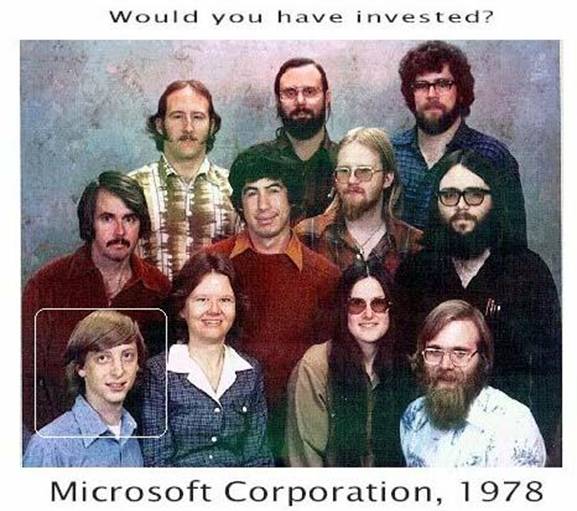
 Ken Thompson (L) and Dennis Ritchie(R), creators of UNIX. Dennis Ritchie improved on the B programming language and called it 'New B'. B was created by Ken Thompson as a revision of the Bon programming language (named after his wife Bonnie). He later called it C.
Steve Woznaik(sitting) and Steve Jobs of APPLE Computers. He was three months late in filing a name for the business because he didn't get any better name for his new company. So one day he told to the staff: "If I'll not get better name by 5 o'clcok today, our company's name will be anything he likes." So at 5 o'clock nobody came up with a nice name, and he was eating APPLE that time, so he kept the name of the company 'Apple Computers'.
Gordon Moore(L) and Bob Noyce(R), founders of Intel. Bob Noyce and Gordon Moore wanted to name their new company 'Moore Noyce'. But that was already trademarked by a hotel chain. So they had to settle for an acronym of INTegrated ELectronics - > INTEL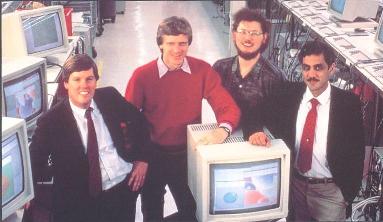
Andreas Bechtolsheim, Bill Joy, Scott McNealy and Vinod Khosla of SUN (StanfordUniversity Network) MicroSystems. Founded by four Stanford University buddies.
Linus Torvalds of Linux Operating System. He initially used the Minix OS on his system which he replaced by his OS. Hence the working name was Linux (Linus + Minix). He thought the name to be too egotistical and planned to name it freax (free + freak + x). His friend Ari Lemmk encouraged Linus to upload it to a network so it could be easily downloaded. Ari gave Linus a directory called linux on his FTP server, as he did not like the name Freax. Thus, Linus kept the name of his new OS to Linux.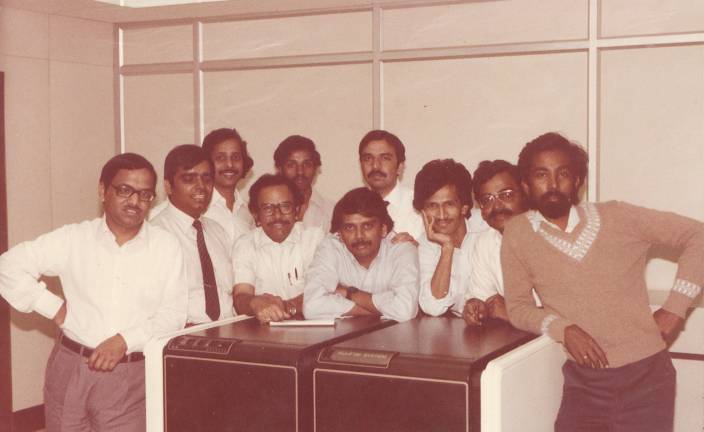
Infosys - when it was just started(1981).
Friday, May 12, 2006
Lessons from Michael Dell's desk
Lessons Learned :-
If you've got a idea, it pays to do something about it.
Sometimes it's better not to ask or to listen when people tell you something cant be done.
With every new growth oppurtunity came a commensurate level of risk.
No matter what your industry, try to identify potential problems early and fix them fast.
Involve your customers early in the development process.
Establish a fluidity and consistency of communications.
The right people in the right job are instrumental to a company success.
You need to embrace an experimental attitude in making deccision.
Make failure acceptable as long as it creates learning oppurtunites.
Delight your customers.
Dont be satisfied in learning only about your industry.... learn as much as you can about your customers previous experience, not only with your competitors, but with other companies as well.
Go beyond selling your product or services, and make yourself valuable to your customers as an advisior.
Speed for market is important for two reason. One is that it creates competitive value that can be shared between buyer and supplier. The other is that when it comes to delivering the latest product - no matter what it is - you're either quick or you're dead.
Dont underestimate the value of information.
Flip the equation: Dont settle for the standard supply/demand relationship. Work towards demand/supply.
Differentiate for the competitive edge.
Learning to thrive on constant change is the next frontier.
Reorient your priorities : Price is not the prevailing factor in the connected ecconomy; as the internet levels the competitive playing field, competitive value is more apt to be found in execution.
Stress personalization, convenience, ease of interaction for your customers.
Friday, May 05, 2006
25 Most Innovative Companies and why?
The Boston Consulting Group-BusinessWeek 2006 list of the Top 25 Most Innovative Companies is based on a survey of more than 1,000 executives at the biggest companies around the world. The resulting ranking is both predictable -- Apple at No.1, Google at No.2 -- and surprising: Where's Motorola? Where's Siemens?
To understand the thinking behind the ranking, they asked the survey respondents to explain their votes. Here are the key reasons behind their belief that, say, Toyota is more innovative than Microsoft.
Apple
• Delivers a stream of extremely well-designed products that create and build new markets from existing technologies/platforms
• Has the ability to create demand by understanding customers' needs and anticipating new ones
• Reintroduces new products at the right time and effectively markets them
• Has built a culture that encourages innovation and accepts the risks entailed
• Delivers a steady stream of innovative and useful technologies, tools, and services against tough competition
• Leverages its brand to move into new business areas
• "There are a lot of search engines -- and then there is Google"
• Is changing the way people interact with information
3M
• Innovation is engrained in the culture
• Empowers and incites employees to innovate
• Effectively balances technology with customer needs
• "Post-Its"
Toyota
• Its leading-edge hybrid technology meets market needs and its manufacturing technologies deliver a quality product
• Uses design, technology, manufacturing, and marketing for maximum market penetration and profits
• Doesn't think conservatively in a conservative industry
Microsoft
• Pushes innovation through technology
• Uses innovation to remain market leader
• Takes existing market innovations and "makes them right"
• Expands beyond core market as new opportunities emerge
GE
• Engages in continuous product and process innovation
• Established the organization to innovate, driven from the top
• Uses metrics to be successful
Procter & Gamble
• Employs "Connect & Develop" model to leverage external resources to drive innovation
• Great brand manager
• Nimble enough to push quickly to market, despite its size
• High patent rate
Nokia
• Maintains market leadership and brand recognition in competitive mobile-phone market
• Clear customer focus
• Great product-portfolio management and fast to market
• Ability to reinvent itself
Starbucks
• Ability to intelligently market a commodity product as an experience customers are willing to pay a premium for
• Creation of a "third place"
• Extension beyond coffee to create a lifestyle brand
IBM
• Draws on intellectual property to be innovative in many areas/ technologies
• Has the ability to repeatedly reinvent itself as tech paradigms shift
• IBM Fellows program
Virgin
• Has a unique approach to international flights
• Extends that thinking to other lines of business focused on customer value
• Willing to take risks
• "It just seems like they're in the business of imagination"
Samsung
• Challenges market with superior product design and understanding of customer needs
• Speedy new product introduction
• Went from low-cost, low-quality electronics company to cutting-edge consumer electronics brand in 10 years
Sony
• Emphasis on product-design innovation
• Always on leading edge of new developments
• Ability to establish new platforms in multiple segments of the consumer market
Dell
• Leader in supply-chain and sales-channel innovation
• Mass-personalization
IDEO
• Offers new approaches and processes to bring ideas to market, including user research, cross-functional teams, and rapid prototyping
• Has a track record of design excellence
BMW
• Challenges industry convention by combining excellent automotive design with cutting-edge technology development to create and market the "Ultimate Driving Experience"
• Has become a leader in automotive telematics
Intel
• Constantly pushing the envelope of computer-chip design
• Great ability to reinvent itself with new technologies
• Rewards and builds on the strengths of its employees
• "Always asking 'What's next?'"
eBay
• Online community breaks the rules to create new ways of doing business
• Constantly developing new ideas and opportunities
IKEA
• Customer-focused marketing and product offerings keep customers coming back
• Has changed the way people buy products in the traditional furniture industry
• Brought design to the masses
Wal-Mart
• Uses technology and pioneers processes to streamline its complex supply chain
• "Hardball approach to global economy"
Target
• The retail experience provides excellent product choice, attractive store layout, and great customer service
• Reinvented their brand with focus on substance, style, and value
• "Redefined the term 'discount retail'"
Honda
• Superior engineering and design capabilities deliver attractive products that meet customer needs
• Relentless focus on quality
• Robotics
Amazon
• Uses its data to derive insight into customer preferences and provide them with a meaningful online experience
• Brought simplicity to e-commerce
RIM
• Its services are changing the way the business world communicates
• Has made mobile e-mail user-friendly
Southwest
• Crafts new approaches to different markets to stay ahead of its competition
• One-make, one-model plane fleet makes for low-cost maintenance and easier training
• Has set the standard for efficiency in its industry, in part by drawing on the ideas of employees
• "Remained profitable even after 9/11"
Wednesday, April 26, 2006
Azim Premji on "Succeeding in a changing world"
Convocation address by Azim Premji, chairman, Wipro Corporation, at the Indian Institute of Management, Ahmedabad on March 23, 2002 |
It is a great privilege to be with you here today and participate in this very important occasion in your life. It has been a real challenge for you to get to this point. You are among the select few to enter and graduating from this prestigious institution. Today will always remain a very memorable day in your lives, marking the threshold to the world of your careers and dreams. The Indian Institute of Management at Ahmedabad pioneered the concept of management institutes in India. It is known not only for its standards of academic excellence, but also for the moving spirit of Professor Ravi Mathai who began this institute against all odds and set its foundation. I compliment all the members of the faculty, the management and the excellent students who have been constantly working hard towards making it such an outstanding institution, not only in India but also around the world. As an Indian, I feel proud that we have an institution like the Indian Institute of Ahmedabad. Institutions such as these have an important role to play when a sea of change surrounds us. They can become lighthouses, showing the way and pointing out the hazards. While change and uncertainty have always been a part of life, what has been shocking over the last year has been both the quantum and suddenness of change. For many people who were cruising along on placid waters, the wind was knocked out of their sails. The entire logic of doing business was turned on its head. Not only business, but also every aspect of human life has been impacted by the change. What lies ahead is even more dynamic and uncertain. I would like to use this opportunity to share with you some of our own guiding principles for staying afloat in a changing world. This is based on our experiences in Wipro. I hope you find them useful. First, be alert for the first signs of change. Change descends on every one equally; it is just that some realize it faster. Some changes are sudden but many others are gradual. While sudden changes get attention because they are dramatic, it is the gradual changes that are ignored till it is too late. You must have all heard of story of the frog in boiling water. If the temperature of the water is suddenly increased, the frog realizes it and jumps out of the water. But if the temperature is very slowly increased, one degree at a time, the frog does not realize it till it boils to death. You must develop your own early warning system, which warns you of changes and calls your attention to it. In the case of change, being forewarned is being forearmed. Second, anticipate change even when things are going right. Most people wait for something to go wrong before they think of change. It is like going to the doctor for a check up only when you are seriously sick, or thinking of maintaining your vehicle only when it breaks down. The biggest enemy of future success is past success. When you succeed, you feel that you must be doing something right for it to happen. But when the parameters for success change, doing the same things may or may not continue to lead to success. Guard against complacency all the time. Complacency makes you blind to the early signals from the environment that something is going wrong. Third, always look at the opportunities that change represents. Managing change has a lot to do with our own attitude towards it. It is the proverbial half full or half empty glass approach. For every problem that change represents, there is an opportunity lurking in disguise somewhere. It is up to you to spot it before someone else does. Fourth, do not allow routines to become chains. For many of us, it is the routine we have got accustomed to that obstructs change. Routines represent our own zones of comfort. There is a sense of predictability about them. They have structured our time and even our thoughts in a certain way. While routines are useful, do not let them enslave you. Deliberately break out of them from time to time. Fifth, realize that fear of the unknown is natural. With change comes a feeling of insecurity. Many people believe that brave people are not afflicted by this malady. The truth is different. Every one feels the fear of the unknown. Courage is not the absence of fear but the ability to manage fear without getting paralyzed. Feel the fear, but move on regardless. Sixth, keep renewing yourself. This prepares you to anticipate change and be ready for it when it comes. Constantly ask yourself what new skills and competencies will be needed. Begin working on them before it becomes necessary and you will have a natural advantage. The greatest benefit of your education lies not only in what you have learnt, but in knowing how to learn. Formal education is the beginning of the journey of learning. Yet I do meet youngsters who feel that they have already learnt all there is to learn. You have to constantly learn about people and how to interact effectively with them. In the world of tomorrow, only those individuals and organizations will succeed who have mastered the art of rapid and ongoing learning. Seventh, surround yourself with people who are open to change. If you are always in the company of cynics, you will soon find yourself becoming like them. A cynic knows all the reasons why something cannot be done. Instead, spend time with people who have a “can-do” approach. Choose your advisors and mentors correctly. Pessimism is contagious, but then so it enthusiasm. In fact, reasonable optimism can be an amazing force multiplier. Eighth, play to win. I have said this many times in the past. Playing to win is not the same as cutting corners. When you play to win, you stretch yourself to your maximum and use all your potential. It also helps you to concentrate your energy on what you can influence instead of getting bogged down with the worry of what you cannot change. Do your best and leave the rest. Ninth, respect yourself. The world will reward you on your successes. Success requires no explanation and failure permits none. But you need to respect yourself enough so that your self-confidence remains intact whether you succeed or fail. If you succeed 90 per cent of the time, you are doing fine. If you are succeeding all the time, you should ask yourself if you are taking enough risks. If you do not take enough risks, you may also be losing out on many opportunities. Think through but take the plunge. If some things do go wrong, learn from them. I came across this interesting story some time ago: One day a farmer's donkey fell down into a well. The animal cried piteously for hours as the farmer tried to figure out what to do. Finally he decided the animal was old and the well needed to be covered up anyway, it just wasn't worth it to retrieve the donkey. He invited all his neighbors to come over and help him. They all grabbed a shovel and began to shovel dirt into the well. At first, the donkey realized what was happening and cried horribly. Then, to everyone's amazement, he quieted down. A few shovel loads later, the farmer finally looked down the well and was astonished at what he saw. With every shovel of dirt that hit his back, the donkey was doing something amazing. He would shake it off and take a step up. As the farmer's neighbors continued to shovel dirt on top of the animal, he would shake it off and take a step up. Pretty soon, everyone was amazed as the donkey stepped up over the edge of the well and trotted off! Life is going to shovel dirt on you, all kinds of dirt. The trick is to not to get bogged down by it. We can get out of the deepest wells by not stopping, And by never giving up! Shake it off and take a step up! Tenth, is spite of all the change around you, decide upon what you will never change – your core Values. Take your time to decide what they are but once you do, do not compromise on them for any reason. Integrity is one such Value. There can be no compromises, no gray. It is either black or white. And when you are in doubt the answer is simple: just don’t do it. Finally, we must remember that succeeding in a changing world is beyond just surviving. It is our responsibility to create and contribute something to the world that has given us so much. We must remember that many have contributed to our success, including our parents and others from our society. All of us have a responsibility to utilize our potential for making our nation a better place for others, who may not be as well endowed as us, or as fortunate in having the opportunities that we have got. Let us do our bit, because doing one good deed can have multiple benefits not only for us but also for many others. Let me end my talk with a small story I came across some time back, which illustrates this very well. This is a story of a poor Scottish farmer whose name was Fleming. One day, while trying to make a living for his family, he heard a cry for help coming from a nearby bog. He dropped his tools and ran to the bog. There, mired to his waist in black muck, was a terrified boy, screaming and struggling to free himself. Farmer Fleming saved the boy from what could have been a slow and terrifying death. The next day, a fancy carriage pulled up to the Scotsman's sparse surroundings. An elegantly dressed nobleman stepped out and introduced himself as the father of the boy Farmer Fleming had saved. "I want to repay you, " said the nobleman. "You saved my son's life." "No, I can't accept payment for what I did," the Scottish farmer replied, waving off the offer. At that moment the farmer's own son came to the door of the hovel. "Is that your son?" the nobleman asked. "Yes," the farmer replied proudly. "I'll make you a deal. Let me take him and give him a good education. If he's anything like his father, he'll grow to a man you can be proud of." And that he did. In time, Farmer Fleming's son graduated from St. Mary's Hospital Medical School in London, and went on to become known throughout the world as the noted Sir Alexander Fleming, the discoverer of Penicillin. Years afterward, the nobleman's son was stricken with pneumonia. What saved him? Penicillin. This is not the end. The nobleman’s son also made a great contribution to society. For the nobleman was none other than Lord Randolph Churchill. And his son’s name was Winston Churchill. Let us use all our talent, competence and energy for creating peace and happiness for the nation. I wish you all the best for success that lies ahead of all of you. |
Tuesday, April 25, 2006
Paying the right salary....
If we increase salaries across the organisation, would we be able to reduce our attrition? Can we build a robust team at minimal cost? How should our salary structure be to attract the best talent in the market? What is more important— internal pay parity or external competitiveness?
Anita Bhatia ateempts to answer the questions.......
In a job market driven by knowledge-workers, fluctuating pay scales and rising attrition, HR heads and experts are breaking their heads trying to find answers to these vexing questions. Developing a salary structure for an organisation or revising the existing structure is not as easy as it seems. For HR policy makers, the most complex exercise is to find a compromise between ‘Internal Parity' (paying people in proportion to the relative value of their job) and ‘External Competitiveness' (paying people in proportion to the market price for the job), and also ensure that the salary is a source of motivating the individual employee. The final a im is to achieve a perfect balance between the three. And, alas, this is easier said than done.
Job Evaluation
For HR managers, it is always better to get the internal compensation structure right before trying to make the pay-slips externally competitive. Whether developing a salary structure from scratch or a revising it completely, it is best to start with a job evaluation. In a job evaluation, the company
• Looks inside, comparing worth of jobs in terms of their internal value.
• Uses the concept of comparable worth and compares all jobs, like and unlike, within
• Works on the principle that jobs requiring comparable skills and accountabilities are paid the same
• Assigns ranking, classifications or points, depending on the specificity of the approach (there are a great many approaches to job evaluation or work compensation)
• Compares its own jobs with those at other companies in setting base pay (if points are used, they become the universal yardstick)
In any case, the better the company describes the work, the better the results that are likely to be achieved from any one these methods—be it ranking of jobs, classification of jobs or giving points to the jobs on the basis of their worth. A job evaluation exercise should typically be attempted when all jobs/ roles in the organisation are defined to the level of minimum ambiguity.
Market Pricing
After having completed the job-evaluation exercise, the next step is to look at the market pricing of similar jobs within the industry. This will help in make the salary structure externally competitive. This is based on one of the simpler notions in economics: supply and demand. You want to pay what the market will bear. This means exploring what the market is paying for the same or similar work and set your scale accordingly. But it is certainly not as simple as it sounds. Policymakers will have to answer a few critical questions like ‘what is our market?', ‘Is it your immediate community? Your region? Is it the competition in your industry, anywhere in the country?' How they answer would depends on the level of job that they are trying to price.
• If they are pricing the jobs of lower skilled employees, who tend to work close to home and who have skills that are readily transferable within the immediate area (with a radius of 10-25 kms from your facility), they may define their market narrowly.
• In that case, district or state data on comparable jobs or a survey of large employees in their area will give the policy makers the going rates.
• That formula is fine, as long as the company is in the low-wage area.
• If local wages are higher than those of the competition in your industry, however, you will have to under-price your jobs (this could hurt your ability to compete for workers), seek additional productivity gains, provide greater employment security or benefits (for example, daycare centre, flexi-time) or settle for lower profitability and take the consequences.
• If, on the other hand, you are pricing higher-level jobs, you need to redefine your notion of your market.
• If you are pricing a professional job, such as an accountant, your market may be the region.
• Or, if you are competing with other companies in the country, for a talented plant manager or marketing manager, your market is national.
The more skilled or industry-specific the job, the closer you must pay to regional or national, rather than local or community going wage. In pricing jobs, companies need a hybrid approach.
Job Slotting
Market pricing is relatively simple as long as there are other companies whose work force is organised in the same way as your own. If that is not the case, your have to use ‘job slotting'—comparing those ‘benchmark' jobs that your can compare and slotting the other jobs in between. For instance, secretaries with a specialised grasp of computer technology may represent a new category to be slotted somewhere above secretaries doing more traditional work.
But that approach becomes more problematic when organisations have no comparable jobs in their market, or when a company is using teams in a market where most employers are organised along functional lines. In such a case, one way to estimate market pay is to evaluate several jobs that represent the mix of work the member does and weigh the result for these narrowly defined jobs or roles according to the mix of responsibilities in the position.
It is always best to have a certain ‘range' of compensation in which you pay people in the same job/role in order to make room for the personal aspirations and motivation quotient of the employee.
Will life become better for HR managers if they resorted to market pricing, job evaluation and job pricing in an effort to build a salary structure for their organisations? At best, it's a beginning. At worst, it's better than drifting without a policy and vision. Naysayers might say that it's hard to imagine a situation where all the employees in a company happily accept the remuneration that is offered to them. Or, that there is nothing close to an ideal salary structure. But that is no excuse to stop trying to evolve a system—where the process of fixing salaries becomes less unpredictable and more logical in nature.
Anita Bhatia is a management post-graduate from the Symbiosis Centre for Management & Human Resource Development (SCMHRD), Pune. She currently works with Polaris Software Lab Ltd. This article is picked from businessworldindia.com.
a ‘Made in India' software product?
Indian IT industry is going places. But when will the world see a ‘Made in India' software product?
Some days back, in an interview, a head of a software company said with a hint of pride that his company was as old as MNCs like Oracle, Microsoft and SAP. And that his company, during its incubation period, also made products that were similar to those made by the US IT giants. I was quite impressed by the statistics and was happy to know that our own IT companies were peers of the global majors—at least in age if not in turnover and product offerings. But the more I thought about it, the more I wanted to know where our IT firms went wrong and why they lost out in the race to dominate the global software product market.
I scanned a few articles on the Net, talked to my peers and seniors. The answers were too predictable: lack of technical knowledge, limited financial resources, lack of creative environment in companies and so on. But even as I tried to understand the interplay of factors that could have directly or indirectly undermined the growth of Indian IT firms, one thing struck me strongly. And from my perspective, I could see that lack of market for software products in India was responsible for the slow growth of the IT industry during the incubation phase.
Put simply, software is created to solve problems. But most of the time, these problems stem from sources generally outside the IT industry. If we look into the history of software giants like SAP, Oracle and Adobe, we would find that they came into existence to solve some business related problems. In the next stage, they ramped up their technical knowledge to create newer domains and technologies. Most of the RDMS or ERP firms owe their existence to companies in verticals like automobile, telecom, banking and aviation. These companies needed IT tools for better inventory management, customer relations, data gathering and analyses. And the software companies came to their rescue, producing a range of products over a couple of decades. These products were the result of collaborative efforts between different teams that worked with a common goal and vision.
Many of these software product companies in the US and Europe were born in the 1970s and 1980s. At that time, India was still struggling with challenges like poverty, lack of education, laggard industrial growth, dearth of technological resources and shortage of manpower. Software was the last thing that crossed the minds of our policy makers. India missed the industrial revolution bus of the 1970s. So software companies in India did not get the opportunities to provide solutions to the kind of problems that beset industries in the US and Europe. The academia of that time was totally out of synch with the software revolution happening in the IT centres of the world. Even in the IITs, computer engineering was not a regular course. So as a cumulative effect, technology development was never given the priority status that it deserved.
Today, though India's software service industry offers a wide range of offerings and services, it still lacks product development capabilities. Many of the IT companies have crossed the $1bn-mark. This is much more than the turnover of small product companies like Macromedia (now acquired by Adobe systems) and Liquid Machines (acquired by Microsoft), and comparable to companies like BEA. But still we are not seeing much happening in the arena of innovation. One problem is that our companies are too big and the revenue per employee is very low compared to product companies abroad. As a result, areas like R&D get neglected for want of financial resources. The few companies that do sink capital in technology development expect a quick return on investment which is generally not possible in product development. The educational system is hardly keeping pace with the technological advancements. It is not surprising that we hardly see the presence of Indian companies in global technological meets. Leave aside creating new technology, I am not sure how many companies actually work on cutting edge technologies like AJAX, XForms, Storage Services and Web Services.
At the same time there are some positive developments too. Over the past few years, niche Indian companies have come up in the horizon. A company like Hungama is already active in the mobile gaming area. To inculcate the idea of innovation we have to undergo a change in the thought process. Rather than thinking from a shorter perspective, the software companies should invest in future. The developers should be given constant training on newer trends in IT industry. If we want to make a mark in the global software arena, we need to become software innovators. And for that to happen, we need to develop an education system that not only nurtures creativity and innovation but also incorporates software development in the curriculum.
---------------------------------------------------------------------------------------------
The article was written for Business World India by Yugal Joshi, a software professional
Tuesday, April 11, 2006
How happy i am?
| You Are 84% Happy |
 It's unlikely that you know anyone happier than you. You know how to be happy, no matter what life throws at you. |
Thursday, April 06, 2006
Sudha Murthy talks about the influence of JRD
Sudha Murthy talks about the influence of JRD Tata
"Everyday when I enter my office I look at them before starting my day. They are pictures of two old people. One is of a gentleman in a blue suit and the other is a black and white image of a man with dreamy eyes and a white beard. People have often asked me if the people in the photographs are related to me. Some have even asked me, "Is this black and white photo that of a Sufi saint or a religious Guru?" I smile and reply "No, nor are they related to me. These people made an impact on my life. I am grateful to them." "Who are they?" "The man in the blue suit is Bharat Ratna JRD Tata and the black and white photo is of Jamsetji Tata." "But why do you have them in your office?"" You can call it gratitude." Then, invariably, I have to tell the person the following story. It was a long time ago. I was young and bright, bold and idealistic.
I was in the final year of my Master's course in Computer Science at the Indian
Institute of Science (IISc) in Bangalore, then known as the Tata Institute. Life was full of fun and joy. I did not know what helplessness or injustice meant. It was probably the April of 1974. Bangalore was getting warm and gulmohars were blooming at the IISc campus. I was the only girl in my postgraduate department and was staying at the ladies' hostel. Other girls were pursuing research in different departments of Science. I was looking forward to going abroad to complete a doctorate in computer science. I had been offered scholarships from Universities in the US. I had not thought of taking up a job in India.
One day, while on the way to my hostel from our lecture-hall complex, I saw an advertisement on the notice board. It was a standard job-requirement notice from the famous automobile company Telco (now Tata Motors). It stated that the company required young, bright engineers, hardworking and with an excellent academic background, etc.At the bottom was a small line: "Lady Candidates need not apply." I read it and was very upset. For the first time in my life I was up against gender discrimination.
Though I was not keen on taking up the job, I saw it as a challenge. I had done extremely well in academics, better than most of my male peers. Little did I know then that in real life academic excellence is not enough to be successful? After reading the notice I went fuming to my room. I decided to inform the topmost person in Telco's management about the injustice the company was perpetrating. I got a postcard and started to write, but there was a problem: I did not know who headed Telco. I thought it must be one of the Tatas. I knew JRD Tata was the head of the Tata Group; I had seen his pictures in newspapers (actually, Sumant Moolgaokar was the company's chairman then).
I took the card, addressed it to JRD and started writing. To this day I remember clearly what I wrote. "The great Tatas have always been pioneers. They are the people who started the basic infrastructure industries in India, such as iron and steel, chemicals, textiles and locomotives. They have cared for higher education in India, such as iron and steel, chemicals, textiles and locomotives. They have cared for higher education in India since 1900 and they were responsible for the establishment of the Indian Institute of Science. Fortunately, I study there. But I am surprised how a company such as Telco is discriminating on the basis of gender."
I posted the letter and forgot about it. Less than 10 days later, I received a telegram stating that I had to appear for an interview at Telco's Pune facility at the company's expense. I was taken aback by the telegram. My hostel mates told me I should use the opportunity to go to Pune free of cost and buy them the famous Pune saris for cheap! I collected Rs 30 each from everyone who wanted a sari. When I look back, I feel like laughing at the reasons for my going, but back then they seemed good enough to make the trip. It was my first visit to Pune and I immediately fell in love with the city.
To this day it remains dear to me. I feel as much at home in Pune as I do in Hubli, my hometown. The place changed my life in so many ways.As directed, I went to Telco's Pimpri office for the interview. There were six people on the panel and I realised then that this was serious business.” This is the girl who wrote to JRD," I heard somebody whisper as soon as I entered the room. By then I knew for sure that I would not get the job. The realisation abolished all fear from my mind, so I was rather cool while the interview was being conducted. Even before the interview started, I reckoned the panel was biased, so I told them, rather impolitely, "I hope this is only a technical interview." They were taken aback by my rudeness, and even today I am ashamed about my attitude.
The panel asked me technical questions and I answered all of them. Then an elderly gentleman with an affectionate voice told me, "Do you know why we said lady candidates need not apply? The reason is that we have never employed any ladies on the shop floor. This is not a co-ed college;this is a factory. When it comes to academics, you are a first ranker throughout. We appreciate that, but people like you should work in research laboratories." I was a young girl from small-town Hubli. My world had been a limited place. I did not know the ways of large corporate houses and their difficulties, so I answered, "But you must start somewhere, otherwise no woman will ever be able to work in your factories." Finally, after a long interview, I was told I had been successful. So this was what the future had in store for me. Never had I thought I would take up a job in Pune. I met a shy young man from Karnataka there, we became good friends and we got married.
It was only after joining Telco that I realised who JRD was: the uncrowned king of Indian industry. Now I was scared, but I did not get to meet him till I was transferred to Bombay. One day I had to show some reports to Mr Moolgaokar, our chairman, who we all knew as SM. I was in his office on the first floor of Bombay House (the Tata headquarters) when, suddenly JRD walked in. That was the first time I saw "appro JRD". Appro means "our" in Gujarati. This was the affectionate term by which people at Bombay House called him. I was feeling very nervous, remembering my postcard episode. SM introduced me nicely, "Jeh (that's what his close associates called him), this young woman is an engineer and that too a postgraduate. She is the first woman to work on the Telco shop floor." JRD looked at me. I was praying he would not ask me any questions about my interview (or the postcard that preceded it). Thankfully, he didn't. Instead, he remarked. "It is nice that girls are getting into engineering in our country. By the way, what is your name?"
"When I joined Telco I was Sudha Kulkarni, Sir," I replied. "Now I am Sudha Murthy." He smiled and kindly smile and started a discussion with SM. As for me, I almost ran out of the room. After that I used to see JRD on and off. He was the Tata Group chairman and I was merely an engineer. There was nothing that we had in common. I was in awe of him. One day I was waiting for Murthy, my husband, to pick me up after office hours. To my surprise I saw JRD standing next to me. I did not know how to react. Yet again I started worrying about that postcard. Looking back, I realise JRD had forgotten about it. It must have been a small incident for him, but not so for me.
"Young lady, why are you here?" he asked. "Office time is over." I said, "Sir, I'm waiting for my husband to come and pick me up." JRD said, "It is getting dark and there's no one in the corridor. I'll wait with you till your husband comes." I was quite used to waiting for Murthy, but having JRD waiting alongside made me extremely uncomfortable. I was nervous. Out of the corner of my eye I looked at him. He wore a simple white pant and shirt. He was old, yet his face was glowing. There wasn't any air of superiority about him. I was thinking, "Look at this person. He is a chairman, a well-respected man in our country and he is waiting for the sake of an ordinary employee." Then I saw Murthy and I rushed out. JRD called and said, "Young lady, tell your husband never to make his wife wait again." In 1982 I had to resign from my job at Telco. I was reluctant to go, but I really did not have a choice. I was coming down the steps of Bombay House after wrapping up my final settlement when I saw JRD coming up. He was absorbed in thought.
I wanted to say goodbye to him, so I stopped. He saw me and paused. Gently, he said, "So what are you doing, Mrs Kulkarni?" (That was the way he always addressed me .) "Sir, I am leaving Telco." "Where are you going?" he asked. "Pune, Sir. My husband is starting a company called Infosys and I'm shifting to Pune." "Oh! And what will you do when you are successful." "Sir, I don't know whether we will be successful." "Never start with diffidence," he advised me. "Always start with confidence. When you are successful you must give back to society. Society gives us so much; we must reciprocate. I wish you all the best." Then JRD continued walking up the stairs. I stood there for what seemed like a millennium. That was the last time I saw him alive. Many years later I met Ratan Tata in the same Bombay House, occupying the chair JRD once did. I told him of my many sweet memories of working with Telco. Later, he wrote to me, "It was nice hearing about Jeh from you. The sad part is that he's not alive to see you today.” I consider JRD a great man because, despite being an extremely busy person, he valued one postcard written by a young girl seeking justice.
He must have received thousands of letters everyday. He could have thrown mine away, but he didn't do that. He respected the intentions of that unknown girl, who had neither influence nor money, and gave her an opportunity in his company. He did not merely give her a job; he changed her life and mindset forever. Close to 50 per cent of the students in today's engineering colleges are girls. And there are women on the shop floor in many industry segments. I see these changes and I think of JRD. If at all time stops and asks me what I want from life, I would say I wish JRD were alive today to see how the company we started has grown. He would have enjoyed it wholeheartedly.
My love and respect for the House of Tata remains undiminished by the passage of time. I always looked up to JRD. I saw him as a role model for his simplicity, his generosity, his kindness and the care he took of his employees. Those blue eyes always reminded me of the sky; they had the same vastness and magnificence."
Sudha Murthy speaks on life and Infosys
Sudha Murthy, wife of Infosys Chairman Narayanamurthy, talking about her life and the story of how Infosys was born:
The first step which one makes in the world as a child, is the one on which depends the rest of our days... My steps were piloted by my family on values like truth, simplicity, love and respect for all. I was born in 1950 in a middle class family. My father Sri R H Kulkarni was a doctor in a government hospital, my mother Vimala Kulkarni was a housewife. I am the second child in a family of three daughters and one son. I spent a great part of my early years with my maternal grandparents. My grandfather, Sri H R Kadim Diwan, was a true Gandhian who opted out of law school because his teacher said that sometimes, he might have to manipulate the truth to win lawsuits. He was 63 years older than me but we were best friends. He was a scholar who inculcated in me a love for books, history, mathematics and India. Without realising it, he also instilled a free and adventurous spirit within me.
I taught my 62-year- old grandmother to read and write... My grandmother, though illiterate was an ardent fan of Triveni, a renowned writer in Kannada. Every Wednesday grandma used to finish her household chores and would be waiting for me to read her Triveni's serial called 'Kashi Yatre'. One Wednesday I was unable to keep our afternoon reading-appointment. Grandma felt helpless and frustrated. There was the magazine, she touched the words but couldn't read them. I asked her, Awwa, do you want to read and write? She replied, I am 62. Will I be able to read now? I was 12 when I became my grandmother's teacher. A year later, grandma began reading 'Kashi Yatre' on her own.
A young man married a girl with leucoderma after reading my novel "Mahaswete"... I love writing. For me, writing is like breathing. I have been writing from a young age and I have written 10 books so far novels, technical and educational books. A boy who had broken off his engagement with his fiancee after learning she had leucoderma decided to marry her after reading my novel "Mahaswete" which was about a girl with leucoderma. To realise that my novel had made a difference in somebody's life was the ultimate reward I could get as a writer.
My parents never bought us jewellery or expensive clothes but we had an extensive library at home... My family was academically oriented and education was a priority in the Kulkarni household. My father had never bought a fridge (which he ultimately did much later in life) but
he would buy us books. I never had any silk saris or jewellery but what I had were books and more books.
My older sister Sunanda is a distinguished doctor. My other sister Jayshree Deshpande is an IIT graduate from Chennai and is married to Gururaj Deshpande whose name appeared in the Forbes list. My brother Srinivas Kulkarni is a world renowned astrophysicist. There was no toilet for girls in my college because girls never went to engineering colleges... I was the first girl to study engineering which was considered a male domain in Hubli. Friends and neighbours tried to discourage my parents saying nobody would marry an engineering graduate.
Since getting me married was not on top of the list at that time, but education was. My parents relented. I joined BE Electricals in 1968 at the BVB College of Engineering in Hubli. In the beginning it was awkward. The college had no ladies room or toilet for girls because there were no girls in college. I had to wait, uncomfortably till I got home. After a year-and-a-half the authorities built a ladies toilet in the college premises. There were 250 boys in the class and I used to be ragged mercilessly. I wanted a degree in engineering and no amount of teasing was going to stop me from reaching my goal. I never missed one day of class in five years of my degree. Because I knew if I was absent even for a day there would be no one to share that day's notes with me. After a year-and-a-half the boys came around. They realised I was no floozy and we went on to become great friends. I stood first in the University. Now, my father was keen that I do M.Tech. So, I went to Bangalore to study MTech at the Tata Institute of Engineering.
Telco, Pune didn't want women engineering students to apply for the job...I had decided to study abroad for a PhD degree or study at MIT when fate intervened. One day, during my last semester of MTech in Bangalore, I came across a notice in college which read: Telco Pune wants young, bright, hard working engineers. There will be a campus interview.... Lady students need not apply. The last line jolted me. Why this discrimination? I bought a post card which I addressed to JRD Tata and wrote:
Benevolent Tatas who have done so much philanthropic work... innovative Tatas who started the first iron and steel industry, textile industries.... I am surprised and ashamed at your attitude toward women students. If you can do this, then anybody can do it.
A week later I received a letter asking me to attend an interview at Telco at their expense. I decided to attend the interview if not for anything else then at least for the free ride and to buy Pune saris for friends and relatives.
At Telco I realized that I was the only candidate called for the interview. I also heard someone whispering, "That's the girl who wrote to the big boss." I thought I will not get the job. When you have no expectations you have no fear. So, I boldly told the panel not to waste time if they were not serious about the interview and saw it as a form of vindication. The creditable panel interviewed me for 2 1/2 hours asking purely technical questions which I answered. At the end one of the panel members, Satyapalli Sarvamurthy, who later became my boss, explained why they did not want ladies at Telco.
People here have to work in shifts, he said, And that might pose a problem for a lady on the shop floor full of men. Secondly, you will have to drive a jeep. Lastly, we spend considerable time and energy training people. This is wasted when a girl trainee gets married as she quits and goes to live with her husband.
I assured them that I was willing to work in shifts and that I will never play my gender card. If my grandmother could learn to read and write at 62, I could learn to drive a jeep at 23. And yes, I will go to live with my husband when I get married. I asked the panel how many of them were married and how many of them have gone to live with their wives. None. When they have followed a 1000- year-old male-favouring tradition why should they expect anything different from me? Yes, I will leave to live with my husband when I get married but unlike a boy who might leave them if he gets an additional 100 rupees at a rival company, I will not quit Telco even if I am offered huge sums of money. I assured them my loyalty.
The panel was flabbergasted and said they will let me know the results of the interview in a week's time. This was a sure sign of getting dumped. And I had no burning desire to work at Telco. When there is no desire there is no fear. I boldly took the panel to task. I demanded an immediate reply since they had technically spent 10 man hours interviewing me. If they couldn't decide on the same day what made them think they could arrive at a conclusion after seven days? To my surprise I was offered a job at Telco, Pune with a salary of Rs 1500 per month which was to be later increased to Rs 5000 per month. They were not willing to provide me with hostel facilities during my two-year training period on the shop floor.
I became morally obligated to take up the job at Telco though I wanted to study further at MIT... I wasn't too keen on the job because I had already decided to go to MIT. But it was my father who made me realise my responsibilities chiding me for writing to JRD on a postcard. You should have done it with some etiquette, he said. He told me that I couldn't and shouldn't back down now.
Your action might make it difficult for other girls to get a job at Telco in the future. They might hold you as a yardstick and you will be setting a bad example. You are morally responsible to take up that job, he bellowed.
I joined Telco Pune in 1974. This incident taught me the importance of having insight in life and never to act on impulse. The men on the Telco shop floor were hostile... In 1974, I became the first woman to work on the shop floor of Telco, a male bastion till then. To say the environment was hostile is an understatement. The men were rude and refused to take orders from me, a woman.
They even prevented me from doing my work since it was always done by their manager, a man. The attitude hurt me but did not affect me. My goal was nothing but to excel at my work. So I was duty bound to overcome all obstacles. I wasn't going to let a few trouser clad homo-sapiens dissuade me. I believe in saving energy for the big fights and refrained from asserting myself. Initially, I would do my work with no interaction with the men. Then I learnt their language as half the battle is won when you can speak the adversary's language.
They began letting me step into their space. My stint at the shop floor has been a boon because today I have a greater cross reference of mechanical industry than Murty. I worked in Jamshedpur and in Bihar too.
It was in Pune that I met Narayan Murty through my friend Prasanna who is now the Wipro chief, who was also training in Telco. Most of the books that Prasanna lent me had Murty's name on them, which meant that I had a preconceived image of the man. Contrary to expectation, Murty was shy, bespectacled and an introvert. When he invited us for dinner, I was a bit taken aback as I thought the young man was making a very fast move. I refused since I was the only girl in the group. But Murty was relentless and we all decided to meet for dinner the next day at 7.30 p.m. at Green Fields hotel on the Main Road, Pune.
The next day I went there at 7 o clock since I had to go to the tailor near the hotel. And what do I see? Mr. Murty waiting in front of the hotel and it was only seven. Till today, Murty maintains that I had mentioned (consciously!) that I would be going to the tailor at 7 so that I could meet him...And I maintain that I did not say any such thing consciously or unconsciously because I did not think of Murty as anything other than a friend at that stage. We have agreed to disagree on this matter. Soon, we became friends. Our conversations were filled with Murty's experiences abroad and the books that he has read.
My friends insisted that Murty was trying to impress me because he was interested in me. I kept denying it till one fine day, after dinner Murty said “ I want to tell you something”. I knew this was it. It was coming. He said, I am 5'4" tall. I come from a lower middle class family. I can never become rich in my life and I can never give you any riches. You are beautiful, bright, intelligent and you can get anyone you want. But will you marry me? I asked Murty to give me some time for an answer. My father didn't want me to marry a wannabe politician,(a communist at that) who didn't have a steady job and wanted to build an orphanage... When I went to Hubli I told my parents about Murty and his proposal. My mother was positive since Murty was also from Karnataka, seemed intelligent and comes from a good family. But my father asked: What's his job, his salary, his qualifications etc? Murty was working as a research assistant and was earning less than me.He was willing to go dutch with me on our outings.
My parents agreed to meet Murty in Pune on a particular day at 10 a. m sharp. Murty did not turn up. How can I trust a man to take care of my daughter if he cannot keep an appointment,asked my father.At 12 noon Murty turned up in a bright red shirt! He had gone on work to Bombay, was stuck in a traffic jam on the ghats, so he hired a taxi (though it was very expensive for him) to meet his would-be father-in-law. Father was unimpressed. My father asked him what he wanted to become in life. Murty said he wanted to become a politician in the communist party and wanted to open an orphanage. My father gave his verdict. NO. I don't want my daughter to marry somebody who wants to become a communist and then open an orphanage
when he himself didn't have money to support his family. Ironically, today, I have opened many orphanages something which Murty wanted to do 25 years ago. By this time I realized I had developed a liking towards Murty which could only be termed as love. I wanted to marry Murty because he is an honest man. He proposed to me highlighting the negatives in his life. I promised my father that I will not marry Murty without his blessings though at the same time, I cannot marry anybody else. My father said he would agree if Murty promised to take up a steady job. But Murty refused saying he will not do things in life because somebody wanted him to. So, I was caught between the two most important people in my life.
The stalemate continued for three years during which our courtship took us to every restaurant and cinema hall in Pune. In those days, Murty was always broke. Moreover, he didn't earn much to manage. Ironically today, he manages Infosys Technologies Ltd,one of the world's most reputed companies. He always owed me money. We used to go for dinner and he would say, I don't have money with me, you pay my share, I will return it to you later. For three years I maintained a book on Murty's debt to me. No, he never returned the money and I finally tore it up after my wedding. The amount was a little over Rs 4000.
During this interim period Murty quit his job as research assistant and started his own software business. Now, I had to pay his salary too! Towards the late 70s computers were entering India in a big way. During the fag end of 1977 Murty decided to take up a job as General Manager at Patni Computers in Bombay. But before he joined the company he wanted to marry me since he was to go on training to the US after joining. My father gave in as he was happy Murty had a decent job, now. We where married in Murty's house in Bangalore on February 10, 1978 with only our two families present. I got my first silk sari. The wedding expenses came to only Rs 800(US$ 17) with Murty and I pooling in Rs 400 each.
I went to the US with Murty after marriage. Murty encouraged me to see America on my own because I loved travelling. I toured America for three months on backpack and had interesting experiences which will remain fresh in my mind forever. Like the time when I was taken into custody by the New York police because they thought I was an Italian trafficking drugs in Harlem. Or the time when I spent the night at the bottom of the Grand Canyon with an old couple. Murty panicked because he couldn't get a response from my hotel room even at midnight. He thought I was either killed or kidnapped.
In 1981 Murty wanted to start INFOSYS. he had a vision and zero capital... initially I was very apprehensive about Murty getting into business. We did not have any business background. Moreover we were living a comfortable life in Bombay with a regular pay check and I didn't want to rock the boat. But Murty was passionate about creating good quality software. I decided to support him. Typical of Murty, he just had a dream and no money. So I gave him Rs 10,000 which I had saved for a rainy day, without his knowledge and told him, This is all I have. Take it. I give you three years sabbatical leave. I will take care of the financial needs of our house. You go and chase your dreams without any worry. But you have only three years! Murty and his six colleagues started Infosys in 1981,with enormous interest and hard work.
In 1982 I left Telco and moved to Pune with Murty.We bought a small house on loan which also became the Infosys office. I was a clerk-cum-cook-cum-programmer. I also took up a job as Senior Systems Analyst with Walchand group of Industries to support the house. In 1983 Infosys got their first client, MICO, in Bangalore. Murty moved to Bangalore and stayed with his mother while I went to Hubli to deliver my second child, Rohan. Ten days after my son was born, Murty left for the US on project work. I saw him only after a year as I was unable to join Murty in the US because my son had infantile eczema, an allergy to vaccinations. So for more than a year I did not step outside our home for fear of my son contracting an infection. It was only after Rohan got all his vaccinations that I came to Bangalore where we rented a small house in Jayanagar and rented another house as Infosys headquarters.
My father presented Murty a scooter to commute. I once again became a cook, programmer, clerk, secretary, office assistant et al.Nandan Nilekani(MD of Infosys) and his wife Rohini stayed with us. While Rohini babysat my son, I wrote programmes for Infosys. There was no car, no phone,just two kids and a bunch of us working hard, juggling our lives and having fun while Infosys was taking shape. It was not only me but the wives of other partners too who gave their unstinted support. We all knew that our men were trying to build something good. It was like a big joint family,taking care and looking out for one another. I still remember Sudha Gopalakrishna looking after my daughter Akshata with all care and love while Kumari Shibulal cooked for all of us. Murty made it very clear that it would either be me or him working at Infosys. Never the two of us together... I was involved with Infosys initially. Nandan Nilekani suggested I should be on the Board but Murty said he did not want a husband and wife team at Infosys. I was shocked since I had the relevant experience and technical qualifications. He said, Sudha if you want to work with Infosys, I will withdraw, happily. I was pained to know that I will not be involved in the company my husband was building and that I would have to give up a job that I am qualified to do and love doing. It took me a couple of days to grasp the reason behind Murty's request. I realised that to make Infosys a success one had to give one's 100 percent.One had to be focussed on it alone with no other distractions. If the two of us had to give 100 percent to Infosys then what would happen to our home and our children? One of us had to take care of our home while the other took care of Infosys.
I opted to be a homemaker, after all Infosys was Murty's dream.It was a big sacrifice but it was one that had to be made. Even today, Murty says,Sudha, I stepped on your career to make mine. You are responsible for my success. I might have given up my career for my husband's sake. But that does not make me a doormat... Many think that I have been made the sacrificial lamb at Narayan Murty's altar of success. A few women journalists have even accused me of setting a wrong example by giving up my dreams to make my husbands a reality. Is'nt freedom about living your life the way you want it? What is right for one person might be wrong for another. It is up to the individual to make a choice that is effective in her life.I feel that when a woman gives up her right to choose for herself is when she crosses over from being an individual to a doormat. Murty's dreams encompassed not only himself but a generation of people.It was about founding something worthy, exemplary and honorable. It was about creation and distribution of wealth. His dreams were grander than my career plans, in all aspects. So, when I had to choose between Murty's career and mine, I opted for what I thought was a right choice. We had a home and two little children. Measles, mumps, fractures, PTA meetings, wants and needs of growing children do not care much for grandiose dreams. They just needed to be attended to. Somebody had to take care of it all.Somebody had to stay back to create a home base that would be fertile for healthy growth, happiness, and more dreams to dream.I became that somebody willingly.I can confidently say that if I had had a dream like Infosys, Murty would have given me his unstinted support.The roles would have been reversed. We are not bound by the archaic rules of marriage.I cook for him but I don't wait up to serve dinner like a traditional wife.So, he has no hassles about heating up the food and having his dinner.He does not intrude into my time especially when I am writing my novels.He does not interfere in my work at the Infosys Foundation and I don't interfere with the running of Infosys. I teach Computer Science to MBA and MCA students at Christ college for a few hours every week and I earn around Rs 50,000 a year.I value this financial independence greatly though there is no need for me to pursue a teaching career. Murty respects that.I travel all over the world without Murty because he hates] travelling.We trust each other implicitly. We have another understanding too. While he earns the money, I spend it, mostly through the charity. Philanthropy is a profession and an art... The Infosys Foundation was born in 1997 with the sole objective of uplifting the less-privileged sections of society.
In the past three years we have build hospitals, orphanges, rehabilitation centres, school buildings, science centres and more than 3500 libraries. Our work is mainly in the rural areas amongst women and children.I am one of the trustees and our activities span six states including Karnataka, Tamil Nadu, Andhra, Orissa, Chandigarh and Maharashtra.I travel to around 800 villages constantly. Infosys Foundation has a minimal staff of three trustees and three office members. We all work very hard to achieve our goals and that is the reason why Infosys Foundation has a distinct identity. Every year we donate around Rs 5-6 crore (Rs 50 - 60 million). We run Infosys Foundation the way Murty runs Infosys in a professional and scientific way. Philanthropy is a profession and an art. It can be used or misused. We slowly want to increase the donations and we dream of a time when Infosys Foundation could donate large amounts of money. Every year we receive more than 10,000 applications for donations. Everyday I receive more than 120 calls. Amongst these,there are those who genuinely need help and there are hood winkers too. I receive letters asking me to donate Rs five lakh to someone because five lakh is, like peanuts to Infosys. Some people write to us asking for free Infosys shares.Over the years I have learnt to differentiate the wheat from the chaff, though I still give a patient hearing to all the cases. Sometimes I feel I have lost the ability to trust people. I have become shrewder to avoid being conned. It saddens me to realise that even as a person is talking to me I try to analyse them: Has he come here for any donation? Why is he praising my work or enquiring about my health, does he want some money from me? Eight out of ten times I am right. They do want my money. But I feel bad for the other two whom I suspected. I think that is the price that I have to pay for the position that I am in now. The greatest difficulty in having money is teaching your children the value of it and trying to keep them on a straight line.... Bringing up children in a moneyed atmosphere is a difficult task.
Even today I think twice if I have to spend Rs10 on an auto when I can walk up to my house. I cannot expect my children to do the same. They have seen money from the time they were born. But we can lead by example. When they see Murty wash his own plate after eating and clean the two toilets in the house everyday they realise that no work is demeaning irrespective of how rich you are. I dont have a maid at home because I dont see the need for one. When children see both parents working hard, living a simple life, most of the time they tend to follow. This doesn't mean we expect our children to live an austere life. My children buy what they want and go where they want but they have to follow certain rules. They will have to show me a bill for whatever they buy.My daughter can buy five new outfits but she has to give away five old ones. My son can go out with his friends for lunch or dinner but if he wants to go to a five star hotel, we discourage it. Or we accompany him.So far my children haven't given me any heartbreak. They are good children. My eldest daughter is studying abroad, whereas my son is studying in Bangalore. They don't use their father's name in vain. If asked, they only say that his name is Murty and that he works for Infosys.They don't want to be recognised and appreciated because of their father or me but for themselves.
I dont feel guilty about having money for we have worked hard for it. But I dont feel compfortable flaunting it.. It is a conscious decision on our part to live a simple, so- called middle class life. We live in the same Two-bedroom, sparsely furnished house before INFOSYS became a succedd. Our only extravagance is buying books and CDs. My house has no lockers for I have no jewels. I wear a stone earring which I bought in mumbai for Rs100. I don't even wear my mangalsutra until I attend some family functions or I am with my mother-in-law. I am not fond of jewellery or saris. Five years ago, I went to Kashi where tradition demands that you give up something and I gave up shopping. Since then I haven't bought myself a sari or gone shopping. It is my friends who gift me with saris. Murty bought me a sari a long time ago. It was not to my taste and I told him to refrain from buying saris for me in the future.I am no good at selecting men's clothes either. It is my daughter who does the shopping for us. I still have the same sofa at home which my daughter wants to change. However, we have indulged ourselves with each one having their own music system and computer. I don't carry a purse and neither does Murty most of the time. I do tell him to keep some small change with him but he doesn't. I borrow money from my secretary or my driver if I need cash. They know my habit so they always carry extra cash with them. But I settle the accounts every evening.
Murty and I are very comfortable with our lifestyle and we dont see the need to change it now that we have money. Murty and I are two opposites that complement each other... Murty is sensitive and romantic in his own way. He always gifts me books addressed to >From Me to You. Or to the person I most admire etc. We both love books. We are both complete opposites. I am an extrovert and he is an introvert. I love watching movies and listening to classical music. Murty loves listening to English classical music.I go out for movies with my students and secretary every other week. I am still young at heart. I really enjoyed watching "Kaho Na Pyaar Hai" and I am a Hrithik Roshan fan. It has been more than 20 years since Murty and I went for a movie. My daughter once gave us a surprise by booking tickets for "Titanic". Since I had a prior engagement that day, Murty went for the movie with his secretary Pandu. I love travelling whereas Murty loves spending time at home. Friends come and go with the share prices... Even in my dreams, I did not expect Infosys to grow like the way it has. I don't think even Murty envisioned this phenomenal success, at least not in 1981. After Infosys went public in 1993, we became what people would call as rich, moneyed people. I was shocked to see what was happening to Infosys and to us. Suddenly you see and hear about so much money. Your name and photo is splashed in the papers. People talk about you. It was all new to me.
Suddenly I have people walking up to me saying, oh we where such good friends, we had a meal 25 years ago, they claim to have been present at our wedding(which is an utter life because only my family was present at my wedding). I dont even know all these people who claim to know Murty and me so well.. But that doesn't mean I don't have true friends. I do have genuine friends, a handful, who have been with me for a very long time. My equation with these people has not changed and vice versa. I am also very close to Narayan Murty's family, especially my sister-in-law Kamala Murty, a school teacher, who is more of a dear friend to me. I have discovered that these are the few relationships and friendships that don't fluctuate depending on the price of Infosys shares. Have I lost my identity as a woman, in Murty's shadow?... No. I might be Mrs Narayan Murty. I might be Akshata and Rohan's mother. I might be the trustee of Infosys Foundation. But I am still Sudha.. I play different roles like all women. That doesn't mean we don't have our own identity. Women have that extra quality of adaptability and learn to fit into different shoes. But we are our own selves still. And we have to exact our freedom by making the right choices in our lives, dictated by us and not by the world.
Monday, April 03, 2006
Loving the job you hate
1. Communicate.
Let the boss know your achievements and problems. Don't boast and don't gripe. Create a sense of teamwork. Define the problem at hand and offer ways to solve it.
2. Do Something for Yourself.
Take on a project that's dear to your heart or set aside time for what you do best. For example, if you got into medicine because you wanted to be a caregiver but find yourself buried in paperwork, find the time to be with your patients. Make an effort to connect with each patient and his or her family.
3. Improve a Bad Relationship.
Some people are born grumpy and simply won't like you. Instead of fretting about it and thinking it's something you did, simply ask the person each day, "Is there anything I can do for you?" This will ease the tension and, over time, may win over the person who has the long knives out for no apparent reason.
4. Delegate.
Never allow process to trump the result. Remember that you can't do everything all the time. Pass off some of the grunt work to a hungry young staffer who needs to learn the basics and a fundamental lesson in life: You don't start at the top, and you earn plumb assignments by working hard in the trenches. If you create a clear path of advancement, the smart employee won't kick when asked to handle routine stuff.
5. Seek Feedback.
Ask your boss and co-workers, "How am I doing?" Make it clear that you seek feedback to improve your performance--not because you crave praise. Show others how feedback can increase their productivity and boost their career choices.
6. Tackle Tough Assignments First.
Get the difficult or unpleasant work out of the way first, because it doesn't improve with age and will look truly hideous after lunch. This also allows you to finish the day with something you find challenging and enjoy.
7. Have A Little Fun.
Work isn't play, but it doesn't have to be mind-numbingly serious all the time. A few quips will boost everyone's morale. If you're not the office wag, encourage the lighthearted goofball in the corner to share his take on why the Yankees are baseball's best team. It beats grinding your teeth for eight hours a day and is likely to boost morale and productivity.
8. Encourage Teamwork.
Doing more with less demands increased productivity. Teamwork is a good way to achieve this goal. Working in teams is a learned skill. If you don't know the basics, learn them and share your insights with others.
9. Body and Soul.
Pay attention to your physical and mental health. Stick to the basics: Eat right, exercise and get enough sleep. If you feel crummy, your job performance will suffer. You don't have to be a corporate guru to figure that out.
10. Get a Life.
People who have interests outside work make better employees, friends, parents and spouses. Take the time to do whatever it is that you're passionate about. No one on his deathbed ever said, "I wish I'd spent more time at the office."